
Recipe Resizing Made Easy
A microlearning experience designed to help home cooks confidently adjust recipes for different serving sizes. Through guided instruction, realistic examples, and hands-on practice, learners develop a simple process for scaling recipes accurately while avoiding common cooking mistakes.


Audience: Home cooks, beginner bakers, and anyone who wants to confidently adjust recipes for different serving sizes.
Skills Demonstrated: Microlearning, Scenario-Based Learning, and Learning Experience Design.
Tools: Articulate Rise, Canva, Miro, and AI-assisted design tools.
Why I Created This Project?
This project started with a baking mistake. A friend and I were making cookies and decided to double the recipe so we would have enough for everyone. Somewhere along the way, the flour measurement was adjusted incorrectly.
The result was a batch of cookies so underbaked and mushy that they were completely inedible.
After the initial shock wore off, we laughed about how such a small measuring mistake could completely change the outcome of a recipe. As I reflected on the experience later, I realized how often people need to adjust recipes but may not feel fully confident in the math behind the process.
Recipes are rarely written for the exact number of servings we need. Whether you're cooking for a larger group, reducing leftovers, or baking for a special event, recipe adjustments happen all the time. Yet many people rely on guesswork rather than a clear process.
That experience sparked a question that ultimately became the foundation for this project:
To answer that question, I designed a microlearning experience that helps learners build confidence through guided practice, realistic examples, and real-world application. Rather than focusing on complex calculations, the course emphasizes a simple process that learners can immediately apply in their own kitchens.
How could I teach recipe resizing in a way that feels approachable, practical, and immediately useful?


What's Inside
The course follows a scaffolded learning approach that gradually builds confidence through explanation, guided practice, and authentic application.

Welcome to the Kitchen
Learners explore common situations where recipe resizing is needed and discover why this skill matters in everyday cooking.
The Simple Formula
Learners learn a straightforward method for calculating recipe conversion factors and adjusting ingredient quantities accurately.
Make it Bigger
Through guided practice, learners apply the formula to increase recipes for larger groups and events.
Learners practice reducing recipes while maintaining accurate ingredient measurements.
Make it Smaller
Smart Adjustments
Learners discover why some ingredients require more thoughtful adjustments than simple multiplication or division. Topics include spices, liquids, baking considerations, and practical cooking tips.
Full Recipe Practice
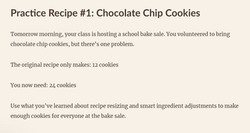
Learners apply everything they've learned to complete realistic recipe resizing activities independently.
Learning Strategy
The goal of this project was not simply to teach recipe math. The goal was to help learners develop a repeatable process they could use whenever they encountered a recipe that needed adjustment.
To support this goal, the course was designed around three key instructional principles:
-
Start with situations learners are likely to encounter in real life.
-
Provide guided practice before expecting independent performance.
-
Focus on application rather than memorization.
The learning experience gradually shifts responsibility from the course to the learner. Each lesson builds on the previous one, allowing learners to develop both confidence and competence before completing full recipe challenges independently.


Design & Development Highlights

Scenario-Based Learning
The course places learners in realistic cooking situations that mirror challenges they may face in their own kitchens. This helps learners connect concepts directly to practical application.

Progressive Practice
Activities move from simple examples to more complex recipe adjustments. This gradual increase in difficulty supports learner confidence and reduces cognitive overload.

Microlearning Decision
Content is organized into short, focused lessons that make the experience approachable and easy to complete in a single sitting.

Immediate Feedback
Practice activities and knowledge checks provide learners with immediate feedback, helping reinforce understanding and correct misconceptions before moving forward.
Reflection
This project reminded me that meaningful learning opportunities often come from everyday experiences. What started as a funny baking mishap eventually became an opportunity to explore how people learn practical, procedural skills and apply them in real-world situations.
As I developed the course, I found myself focusing less on the calculations and more on learner confidence. The biggest design challenge was ensuring the experience felt useful and approachable rather than mathematical. I wanted learners to leave with a process they could confidently apply the next time they needed to adjust a recipe.
If I continue developing this project, there are several enhancements I would:
-
Add branching cooking scenarios that allow learners to experience the consequences of common recipe resizing mistakes.
-
Incorporate more visual demonstrations showing ingredient measurements and conversions.
-
Create downloadable kitchen reference guides that learners could use while cooking.
-
Expand the final practice section with additional recipe types such as soups, casseroles, and baked goods.
-
Include optional challenge activities for learners who want to practice more advanced recipe adjustments.
This project strengthened my ability to transform a simple real-world problem into a meaningful learning experience and reinforced the value of designing instruction that feels immediately relevant and useful to learners.
 |  |  |
|---|---|---|
 |  |  |
 |  |