


Audience: Healthcare front desk staff, medical receptionists, administrative coordinators, and patient-facing support roles in outpatient clinic settings.
Responsibilities: Needs analysis, scenario scripting, AI prompt engineering, Storyline development, scoring rubric design, and publishing.
Tools: Articulate Storyline 360, devlin.ai (AI simulation engine), and Miro
Why I Created This Project?
A few years ago, my grandfather came home from a routine clinic visit visibly frustrated. He had waited almost two hours with no explanation, no updates, and no one acknowledging that his time mattered. What stuck with me was not the wait itself. It was the silence. Nobody told him anything. He sat there feeling invisible.
That conversation stayed with me when I began exploring AI-powered simulation tools. I kept thinking about the person on the other side of that waiting room window. They likely had no idea how to handle it. They may have wanted to help but did not know what to say. No training had ever put them in that moment before it happened.
This project is my attempt to close that gap. By pairing Articulate Storyline with devlin.ai, I built a simulation where learners step into exactly that moment: a clinic running an hour behind, a frustrated patient named Andrew approaching the front desk, and the question of what you say next. The AI responds to whatever the learner types, making every conversation genuinely unscripted and every debrief personal.


The Learning Gap
Healthcare front desk staff typically receive onboarding focused on systems and compliance: scheduling software, check-in procedures, HIPAA basics. While many receive some type of de-escalation training, they rarely get structured practice in patient-facing communication under emotional pressure. When something goes wrong, like an emergency that cascades into a waiting room full of frustrated patients, staff are expected to improvise.
"Adults learn best when they can experience consequences, reflect on them, and try again rather than being told what to do." Knowles, Adult Learning Theory
Staff either over-apologize without offering solutions, or jump straight to logistics without acknowledging how the patient feels. Neither approach de-escalates well.
Without This Training
With This Simulation
Learners practice empathy-first responses, manage expectations honestly, and offer concrete next steps, with immediate scored feedback on every attempt.
What Learners Walk Away able to do
1 Acknowledge before explaining
Validate the patient's frustration with a brief empathy statement before addressing logistics or offering explanations.
2 Communicate honestly under pressure
Provide current, accurate wait information rather than vague or overly optimistic estimates that erode patient trust over time.
3 Offer a concrete resolution path
Propose a specific, actionable next step such as a rescheduled appointment with documented context rather than open-ended reassurances.
4 Maintain a calm, professional tone throughout
De-escalate without becoming defensive or overly apologetic, keeping both the patient's dignity and the clinic's reputation intact.
Analysis and Design
I started with a question that had been sitting with me since my grandfather's experience: what does a front desk worker actually reach for in that moment? To find out, I did what most designers do before they have access to a real SME — I read. Healthcare forums, patient experience articles, front desk training discussions. The picture that emerged was consistent: the gap was rarely attitude. Staff wanted to help. What they lacked was a framework and any opportunity to practice before the moment arrived.
From that research, I built a hypothetical SME interview to model what a real needs analysis conversation might look like: the questions I would ask a medical office manager, the answers I would likely hear, and where those answers would lead. It is not a transcript of a real conversation. It is a demonstration of the analytical process: how I would approach a discovery conversation, what I would listen for, and how the findings would translate directly into design decisions.
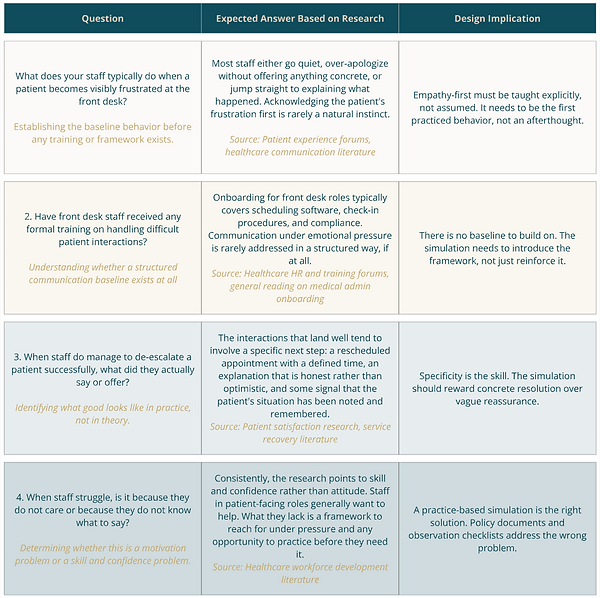
Every path pointed to the same place: staff needed to practice the moment before they lived it, not read about it afterward.
Once I knew what I was building, I needed to know who I was building it around. I created Andrew: a 38-year-old executive who took half a day off work for a one o'clock appointment that is now 45 minutes overdue, and who has already asked once and been left without a real answer. Writing Andrew carefully was one of the most important decisions I made in this project, because the simulation only works if he feels real.
With Andrew defined, I turned that character into a system prompt for devlin.ai. Writing a prompt that makes an AI behave like a specific, emotionally consistent person turns out to be a craft in itself. Too loose and Andrew becomes a pushover who accepts any response. Too rigid and the conversation feels scripted. I went through several rounds of testing and refinement before Andrew felt right: difficult but fair, frustrated but reachable


Before touching Storyline, I mapped the full experience on paper. I wanted to be intentional about what each screen needed to do and how little I could get away with putting on it. The interface had to disappear so the conversation could take center stage. Four slides: a title screen that set the scene, the chat interface, a brief complete state while results loaded, and the debrief.

Building in Storyline was mostly an exercise in restraint. The hospital reception illustration set the scene. The illustrated character gave Andrew a physical presence. The devlin.ai widget dropped in as a web object and sat in the left panel of the slide, the conversation framed against the waiting room behind it. The hardest part was making the two feel like one: adjusting the overlay, the positioning, the padding, until it stopped feeling like two things layered on top of each other and started feeling like a single environment.
 |  |  |
|---|---|---|
 |
The last piece was the scoring rubric and feedback copy. The rubric itself came from the learning objectives: empathy first, honest explanation, concrete resolution, calm tone, and a bonus for actually checking with staff rather than guessing. But I also built in deductions for the specific mistakes I expected to see such as: making promises the clinic could not keep, dismissing the frustration, and getting defensive. The feedback text had to model the same behavior the simulation was teaching. If the debrief was cold or generic, it would undercut everything the learner just practiced.


Once the build was complete I tested it deliberately, including intentionally failing runs to stress-test how Andrew responded to bad answers. That testing revealed a problem: the initial parameters made the scenario too difficult. Andrew escalated too quickly and the scoring was too punishing for honest attempts that lacked polish. I adjusted the thresholds, softened some of Andrew's escalation triggers, and ran it again until the difficulty felt fair rather than punishing. Getting that calibration right took longer than building the simulation itself.
How the Simulation Performed
Most of the completion data reflects my own testing runs, including intentional failures I used to calibrate the scenario and verify that Andrew responded correctly to poor responses. The 36% pass rate and 59% average score are not a measure of learner performance, they are a record of the calibration process. What they do confirm is that the simulation is doing its job: Andrew does not accept vague answers, the scoring catches the subtle mistakes, and a learner who passes has genuinely practiced the skill.

Reflection
This project pushed me into new territory combining a traditional authoring tool with a live AI engine, and it taught me quite a bit about promt engineering. Looking back, there are several things I would do differently in a future iteration or a real client deployment:
-
Collect more specific data. This was a portfolio project without a live learner population. In a real clinic setting, I would partner with a site manager to survey staff 30 days post-training, measuring whether patient complaint incidents decreased and whether staff reported feeling more confident during delay situations.
-
Build a harder scenario tier. Andrew is frustrated but ultimately reasonable. A stretch version of this module would feature a patient who escalates more dramatically, threatening to leave or demanding a supervisor, to challenge learners who found the base scenario manageable.
-
Explore voice-based simulation. Real de-escalation happens out loud. A voice-enabled version where learners speak their response and the AI evaluates tone and pacing would be a far more authentic representation of the actual skill being trained.
-
Add a pre-simulation primer. Dropping learners directly into the scenario assumes they already understand the empathy-first framework. A short two-minute primer covering the core model (acknowledge, inform, resolve) before the simulation begins would prime better performance and make the scored debrief more meaningful.