
Learners Island Teacher Orientation
A professional onboarding experience developed for new instructors joining an adult English language academy. This module equips teachers with the platform knowledge and instructional expectations needed to deliver consistent, high-quality lessons from their very first day.


Audience: Newly hired instructors at a private adult English language school, a mix of experienced educators and first-time teachers.
Responsibilities: Stakeholder consultation, content analysis, instructional design, storyboarding, wireframing, visual design, eLearning development, scenario writing, assessment design, video production, and QA & revision.
Tools: Articulate Storyline 360, Synthesia, Camtasia, Audiate, Miro, Microsoft PowerPoint, Google Suite, and AI-assisted design tools
Why I Created This Project?
This is a real project, and it started from the inside. Before transitioning into instructional design, I worked in program management at an adult English language school and watched the onboarding process up close. As the program grew, so did the complexity of what new instructors needed to know. What had started as a manageable orientation had turned into a two-hour presentation that managers delivered manually, every time, for every new hire.
The inconsistency was a real problem. The quality of the onboarding experience depended entirely on who was doing the training that day. Thing could easily be missed. Information was hard to retain after a two-hour information session. And there was no single place for new teachers to go back and reference what they had learned.
I knew there was a better way. So when the opportunity came to build it, I did. I wanted to create something the school could rely on for years to come, something consistent, scalable, and actually worth a new teacher's time.
To protect client confidentiality, the company name, identifying details, and confidential information have been modified throughout this case study.


Starting With the Content
Before I could design anything, I needed to get my arms around the content. There was a lot of it and it wasn't organized in a way that would translate directly into a learning experience.
I started with a thorough content analysis, mapping out everything stakeholders needed new teachers to know. That process helped me see patterns, identify gaps, and figure out what actually needed to be learned versus what could live in a reference document.
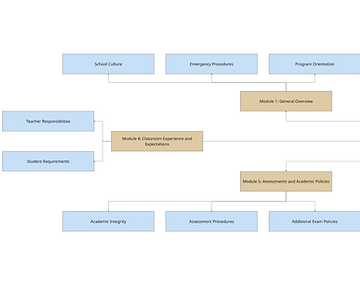
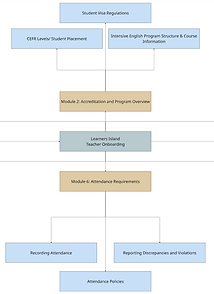
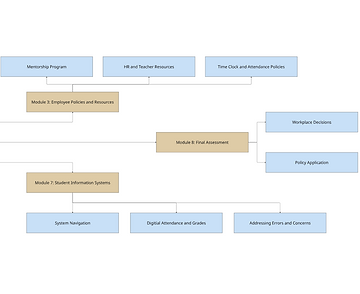
From that analysis, I organized everything into eight focused modules. The structure was intentional each module built on the one before it, and the progression felt natural rather than arbitrary.

Designing the Experience
Once I had the content structure mapped out, I had to figure out how to bring it to life in a way that didn't feel like reading a policy manual online.
That's where the island theme came in.
The school had a culture I wanted to honor, and I saw an opportunity to use visual theming as more than decoration. The island navigation wasn't just a design choice it gave the course structure, made navigation intuitive, and created an immediately welcoming impression for new hires. Walking into a new job is already a lot. The course should feel like an invitation, not a checklist.
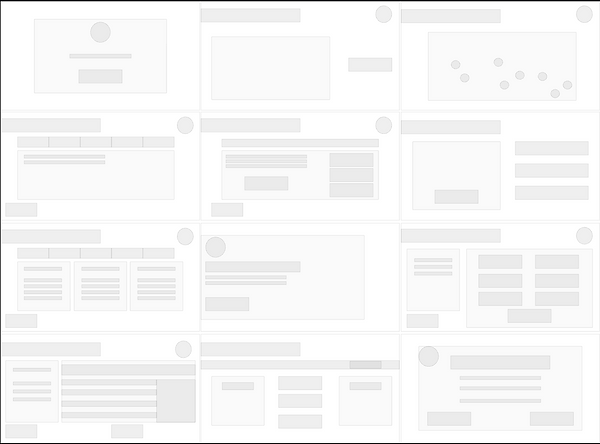
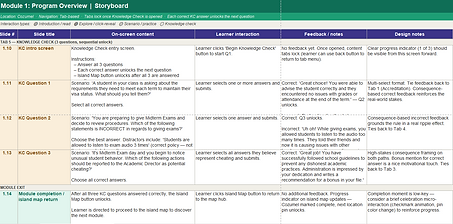
Before a single slide was built, I created detailed storyboards and wireframes. These were essential not just for keeping myself organized, but for giving stakeholders something concrete to react to before development was underway. Catching alignment issues at the storyboard stage is always better than catching them after you've built the whole thing.


Building It
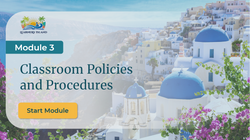
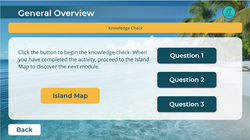
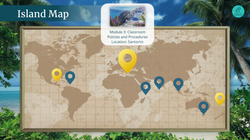
The final course was built in Articulate Storyline 360, anchored by the island navigation map learners used to move through each module.
Video content played a key role in making the course feel human. I used Synthesia for AI-presenter videos, Camtasia for screen recording and editing, and Audiate for audio production a combination that let me produce polished video segments efficiently without sacrificing quality.

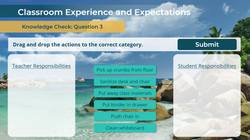
Throughout each module, I incorporated interactions that kept learners active rather than passive:
-
Interactive island navigation map - the visual hub for the entire experience
-
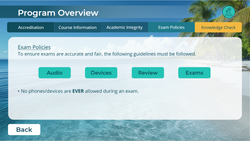
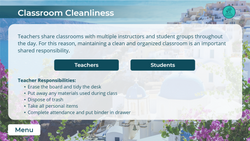
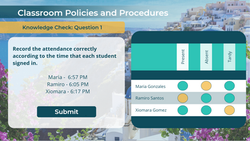
Click-and-reveal exploration - learners uncovered content rather than just reading it
-
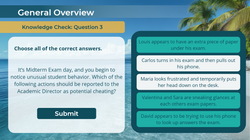
Embedded knowledge checks - placed within each module to reinforce learning before moving on
-
Scenario-based questions - short, realistic practice moments woven throughout
-
Resource and reference tools - so teachers could revisit key information after completing the course
 |  |  |
|---|---|---|
 |  |  |
 |  |  |
 |
The Scenario-Based Assessment
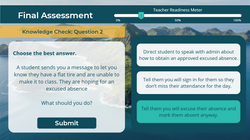
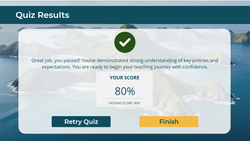
The course ended with a final assessment built around realistic workplace situations: the kinds of decisions new teachers actually face in their first weeks on the job.
Rather than a straightforward quiz, each question placed learners in a specific moment: a student behaving suspiciously during an exam, a scheduling conflict, an attendance question. Learners chose a response and immediately saw a consequence that felt true to life. A good decision might earn a note of recognition from administration. A poor one might mean assessments have to be rewritten, or a situation escalates in a way that is hard to walk back.
If a learner answered incorrectly, they saw that consequence play out and returned to try again. The goal was not to penalize wrong answers. It was to make sure every teacher left the course having practiced the right response, not just having read about it.

"Amanda is dedicated to achieving high-quality, professional projects. Her attention to detail, combined with carefully chosen language and thematic choices designed to reflect our school’s aesthetics, resulted in an engaging, interactive, and comprehensive module-based training program. For all future needs, we know that we can depend on Amanda’s creatively crafted projects and stellar work ethic."Andrea Alexander, Academic Director
Reflection
This project pushed me to think carefully about the difference between delivering information and designing learning. Policy content is notoriously hard to make engaging but it's also content where clarity really matters. Getting it right meant making intentional choices at every step: how to sequence the modules, where to put interactions, how to write scenario choices that felt real without being overwhelming.
The stakeholder collaboration was a highlight too. I built regular feedback loops into the process, and that made the final product better not just more aligned with their expectations, but actually more learner-centered because of the conversations we had along the way.
And the island theme reminded me why design decisions deserve to be taken seriously. When it's done with intention, visual design doesn't compete with learning it supports it.