
90 Days to Leadership
A scenario-based leadership simulation that allows first-time managers to practice difficult conversations, delegation, and performance management in a risk-free environment. Drawing from my own transition into leadership, I designed this experience to explore how new managers develop confidence through experience, feedback, and reflection.


Audience: First-time managers developing leadership skills related to coaching, delegation, performance management, and team communication.
Responsibilities: Owned the end-to-end design process, including needs analysis, scenario design, storyboarding, visual design, interaction development, variable mapping, and course implementation.
Tools: Articulate Storyline 360, Miro, PowerPoint, Google Suite, and AI-assisted design tools.
Why I Created This Project?
Early in my experience as an ESL Program Manager, I learned that leadership is rarely about having the perfect answer. More often, it involves navigating difficult conversations, supporting employees through challenges, and making decisions that impact an entire team. As I gained experience, I noticed that many of the most important leadership lessons came through practice, reflection, and feedback rather than formal training alone. While many leadership courses focus on theory, I wanted to create an experience that allowed learners to practice leadership in realistic workplace situations.


To translate these experiences into a meaningful learning solution, I focused on the decisions that often define a manager's success during their first months in the role. I began identifying the workplace situations that have the greatest impact on team performance, employee development, and overall team dynamics.
The Problem
First-time managers are often promoted based on individual performance, yet receive little preparation for the interpersonal and team-dynamic challenges that define leadership success. Traditional onboarding and leadership training tends to be lecture-based, leaving new managers without the rehearsal time they need to build confidence before high-stakes moments arrive
"You can read about giving feedback all day. Until you have practiced saying the words out loud, you do not really know how to do it."
New managers lack low-risk environments to rehearse difficult conversations before they happen with real employees.
No Safe Practice Space
Theory and Practice Gap
Most leadership programs teach concepts but rarely simulate the ambiguity and pressure of real management decisions.
Delayed Feedback Loops
Without immediate, meaningful feedback, new managers repeat ineffective behaviors without realizing the impact on their teams.
Analysis & Learning Strategy
My own management transition served as the primary lens for analysis. I mapped the moments where I felt most underprepared and where coaching, reflection, and trial and error made the greatest difference. To validate and deepen that picture, I consulted subject matter experts with experience in leadership development and organizational learning.

The iterative process began by defining the core scenarios grounded in real management challenges and then stress-testing them against both the SME input and my own experience. Scenarios were refined until each one felt true to the messy reality of early leadership, not a textbook simplification of it.
Design
Design began with a clear goal: put learners inside decisions rather than in front of information. Every structural and visual choice flowed from that intention. The simulation needed to feel like a real workplace context, not a course, so the design language stayed intentionally grounded and low on ornamentation.
Design Goal Design Solution
Create realistic practice opportunities
Measure leadership growth
Reinforce consequences
Support learner decision-making
Scenario-based interactions
Leadership Effectiveness and Team Morale variables
Branching outcomes
Megan coaching character
Storyboarding
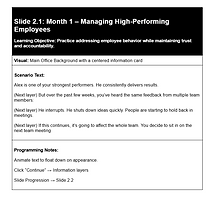
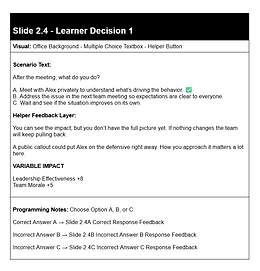
Before development, I created detailed storyboards to map learner decisions, coaching interactions, feedback pathways, and scenario outcomes. This process helped ensure that each scenario aligned with the learning objectives and provided meaningful opportunities for reflection and practice.





Wireframing
Before any visual work began, I outlined the learner journey from start to finish. This low-fidelity stage focused on how a learner would move through each scenario, what choices were available at each decision point, and where consequence and feedback would appear. The wireframes went through several rounds of revision as the design process was highly iterative, allowing me to refine the flow and logic before committing to any visual decisions.

Visual and Interaction Design
The visual design prioritized clarity and immersion. A restrained color palette, consistent backgrounds, and character-based dialogue worked together to keep the learner anchored in the scenario. Each of these elements went through multiple iterations to ensure the overall look felt grounded and purposeful rather than decorative.
 |  |  |
|---|---|---|
 |  |  |
Development
With the design work complete, I moved into building the full experience. Each scenario was assembled and tested individually before being reviewed as a whole. When something felt too clean or a choice felt too obvious, that was the signal to revisit and push the work closer to the reality of what new managers actually face.





Reflection
Looking back, two things stand out as areas I would approach differently.
-
More learner interaction. The simulation relied heavily on dialogue choices, which kept learners moving through the experience but did not always push them to reflect deeply. Adding opportunities like short written responses, self-assessments, or structured reflection prompts would give learners a chance to connect the scenarios to their own experiences and make the learning more personal and transferable.
-
More realistic situational concepts. While the scenarios worked, they could have been messier and more ambiguous. Real management situations rarely have a clearly better option, and leaning further into that complexity would have made the practice feel more authentic. Spending more time with SMEs stress-testing the realism of each situation would have helped close that gap.